
Insights
Farnborough 2026 · Day 1 Field Notes
Day 1 field notes from Farnborough International Airshow 2026 — the announcements, and the conversations underneath them.
Field notes from Farnborough 2026: Day 1 · Day 2 · Day 3
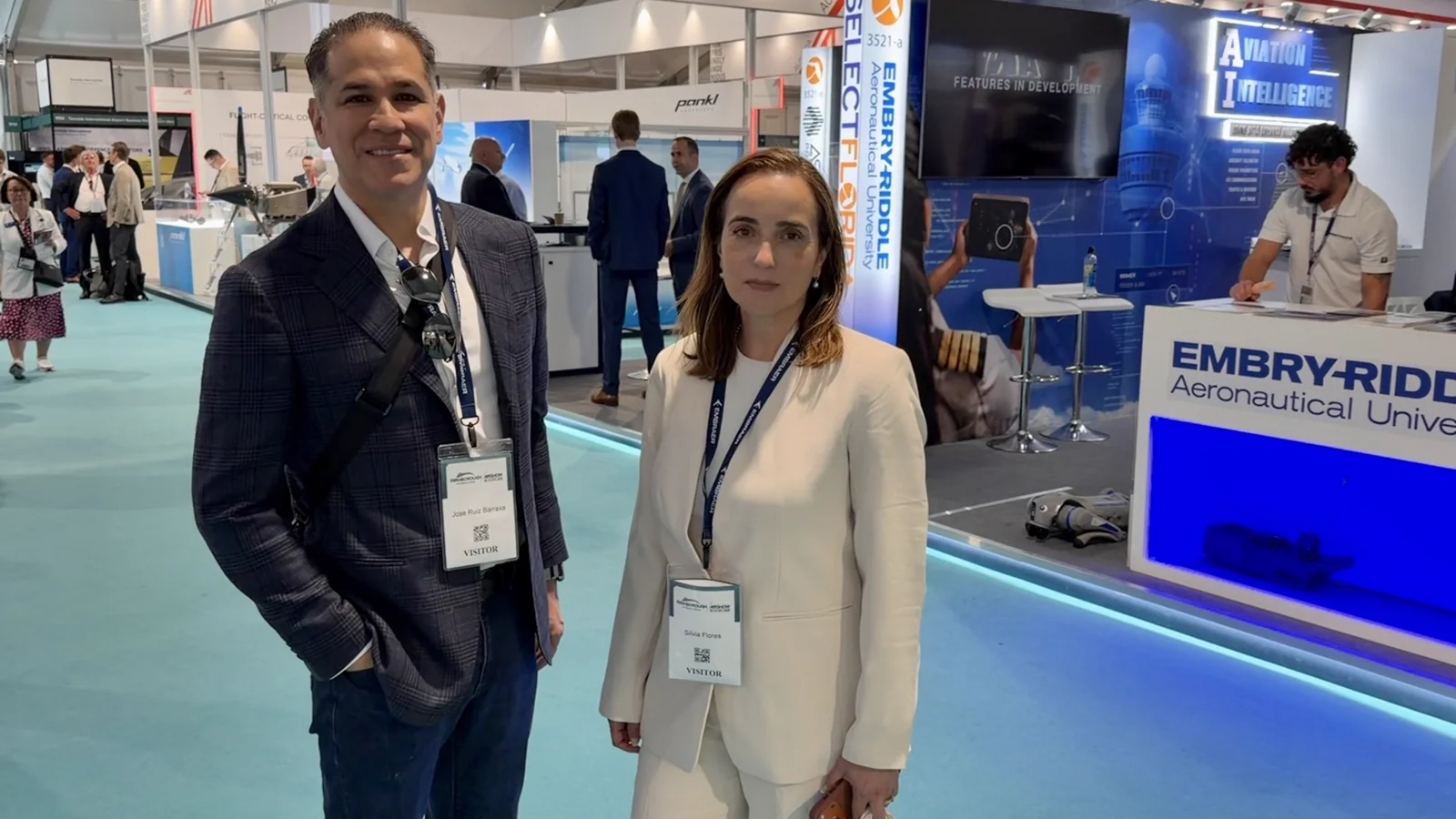
Silvia Flores and I opened Farnborough alongside our IMD International Search Group Aerospace Practice colleagues yesterday. Monday’s trade day set the tone for the week — the aircraft and the technology capture the attention, but the most valuable part of the day has been the conversations.
Reconnecting with clients. Meeting candidates. Exchanging perspectives with leaders across aerospace and aviation. Those hours between announcements are where the show actually earns its place on the calendar.
What moved on the show floor
Monday delivered a strong commercial opening. SMBC Aviation Capital’s order for 100 Boeing 737 MAX jets led the day, alongside Riyadh Air’s six Airbus A350-1000s and its 28 additional 787s, and Philippine Airlines’ 15 787-10 Dreamliners (Reuters). Engine commitments followed in the same rhythm — long-cycle bets on the next decade of narrowbody and widebody fleets.
The other headline was structural: defense companies account for roughly half of a record 1,600 exhibitors this year — a meaningful shift for a show whose commercial-aviation roots run back to 1948. Lockheed Martin’s unveil of a lower-cost PAC-3 ACE interceptor sat neatly inside that shift, aimed at the same drone-and-missile-density problem that keeps coming up in our conversations with defense-adjacent clients.
Airline executives also pushed back on the pace of the next-generation commercial jet conversation, urging Boeing and Airbus not to rush a new platform before the underlying technology is mature. That caution has direct consequences for the leadership profiles OEMs and tier-ones will need through the back half of this decade.
The conversations underneath the announcements
Our discussions moved naturally between the industry’s immediate realities and its longer-term future — growth, innovation, supply-chain pressures, evolving leadership requirements, and the talent needed to turn ambition into execution.
A few threads recurred across the day:
- Program transfers into Mexico are accelerating. Dual-source strategies keep pushing technical leadership demand into the Bajío and the northern corridors faster than the local pipeline can absorb. The plant-leader profile that succeeds in a certificated aerospace transfer is narrower than the general manufacturing profile, and the market knows it.
- Bilingual engineering leadership is still the scarcest resource. Certification bodies on both sides of the Atlantic have tightened their expectations around continuity in engineering leadership. That raises the bar on VP Engineering and Chief Engineer profiles who can be credible in front of the FAA, EASA, and their counterparts simultaneously.
- Defense demand is reshaping the leadership market adjacent to commercial aerospace. The talent flows we track between commercial programs and defense primes have thickened. That has consequences for retention design at the tier-one level.
- Matrixed reporting lines are the new normal. Program leadership hires increasingly answer to two or three geographies at once. Structuring a retained search — and the assessment behind it — for that reality is a different exercise than a single-country mandate.
Why Farnborough still matters
Farnborough remains a powerful reminder that the future of aerospace will be shaped not only by new technologies, but by the people and organizations capable of deploying them. The orders will fluctuate cycle to cycle. The leadership infrastructure — the engineering benches, the certification-fluent VPs, the general managers who can carry a program through a transfer — is what actually determines whether the announcements convert into aircraft on the ramp.
A strong first day, and more conversations ahead. If you are here through the week and would like to compare notes, the simplest route is through the practice and we will coordinate.
Field notes will continue as the week develops.
Jose J. Ruiz is CEO and Managing Partner of Alder Koten, President of IMD International Search Group, and Chairman of Anker Bioss.