
Insights
Farnborough 2026 · Day 3 Field Notes
Day 3 field notes from Farnborough International Airshow 2026 — autonomous systems take centre stage, and a 1994 SAE slogan finally reads as reality.
Field notes from Farnborough 2026: Day 1 · Day 2 · Day 3
Advancing mobility: land, sea, air, and space.
Back in 1994, during my time as President of our SAE International student chapter, that slogan felt bold. Wrapping up the 2026 Farnborough International Airshow this week, it reads as an absolute reality.
The overlap across aviation, aerospace, and defense — and how closely it mirrors what we see at SAE events and even CES — is striking. Cyber-physical networks and unmanned systems are officially everywhere.
Day 3 was the day the show made that shift impossible to miss.
What moved on the show floor
Wednesday’s commercial-aerospace side was quiet by design — the chalets went softer while the defense and autonomy halls filled up (Forecast International — Flightline Daily). The headlines were structural rather than transactional.
- BAE Systems unveiled Bronte Max, Britain’s first autonomous collaborative combat aircraft — roughly the size of a Hawk trainer and designed to fly alongside Typhoon, F-35, and the future Tempest with electronic-warfare and precision-strike capabilities (Defense Security Monitor — Frontline Flight Day 3).
- BAE also unveiled Black Thorn, a modular warhead available in three sizes and designed to be adapted quickly across drones, missiles, counter-drone interceptors, and other autonomous platforms. Black Thorn was already selected for Frankenstein Technologies’ Mark 1 low-cost air-defense missile — an explicit bet on affordability at scale for counter-drone.
- General Atomics AeroTec Systems unveiled the DO 228 NXT, a modernized version of the four-decade-old airframe with new avionics, interiors, and systems. Wing and flight-control production is returning to Oberpfaffenhofen near Munich — a sovereign-capability signal that fit the day’s tone.
- The UK Defence Secretary set out a £298 billion plan with autonomous aviation at its centre — a policy anchor that reinforces how quickly national industrial strategy is being rewritten around cyber-physical and unmanned systems.
- Boeing outlined an expanded European defense strategy — more in-country partnerships, more local manufacturing and engineering, particularly around uncrewed systems and military aircraft, to align with European governments’ sovereign-capability priorities.
- BermudAir became a new A220 customer with a firm order for 10 A220-300s — the airline’s first-ever Airbus order. AerCap filed 15 additional 787-9s with substitution rights to the 787-10, extending the largest Dreamliner lessor portfolio further. Airbus announced a €5 billion (~$5.7 billion) share buyback and a projected near-doubling of profits by 2029, while confirming it is studying stretched variants of both the A350 and A220 families. Textron Aviation confirmed the Beechcraft Denali single-engine turboprop has entered the final phase of flight testing.
Autonomy, modularity, and sovereign industrial footprint were not sub-themes on Wednesday. They were the day.
The 1994 slogan, in 2026 clothes
I keep returning to that SAE student-chapter slogan because it landed differently this week.
The transformation on the show floor goes far beyond the end products. It is fundamentally rewriting the rules of industrial capacity itself, and the pattern is now legible across three simultaneous shifts:
- Manufacturing labor is shifting rapidly from low-cost manual assembly to high-skilled, AI-augmented human-machine collaboration. The additive-manufactured engine components, the autonomous-system integration halls, the software-first cockpits — all of them require a different plant floor and a different plant leadership profile than the one the industry hired for a decade ago.
- Availability of energy is quickly overshadowing the availability of labor as a deciding factor in manufacturing site selection. The conversations we had this week with primes and tier-ones about where to place the next program leaned heavily on grid reliability, on-site generation, and clean-energy access — variables that used to sit two layers down in the site-selection deck. They are moving up.
- National competitiveness is no longer defined by cheap labor rates, but by a country’s cyber-physical infrastructure, software-driven agility, and speed of automated deployment. The £298 billion UK plan, Boeing’s European sovereign-capability posture, and the return of DO 228 production to Bavaria are three data points from a single day pointing in the same direction.
We are standing at a monumental inflection point with profound consequences for the global workforce and for national sovereign capability. That is the sentence I would not have written in 1994. In 2026 it is field observation.
What this means for aerospace and defense leadership
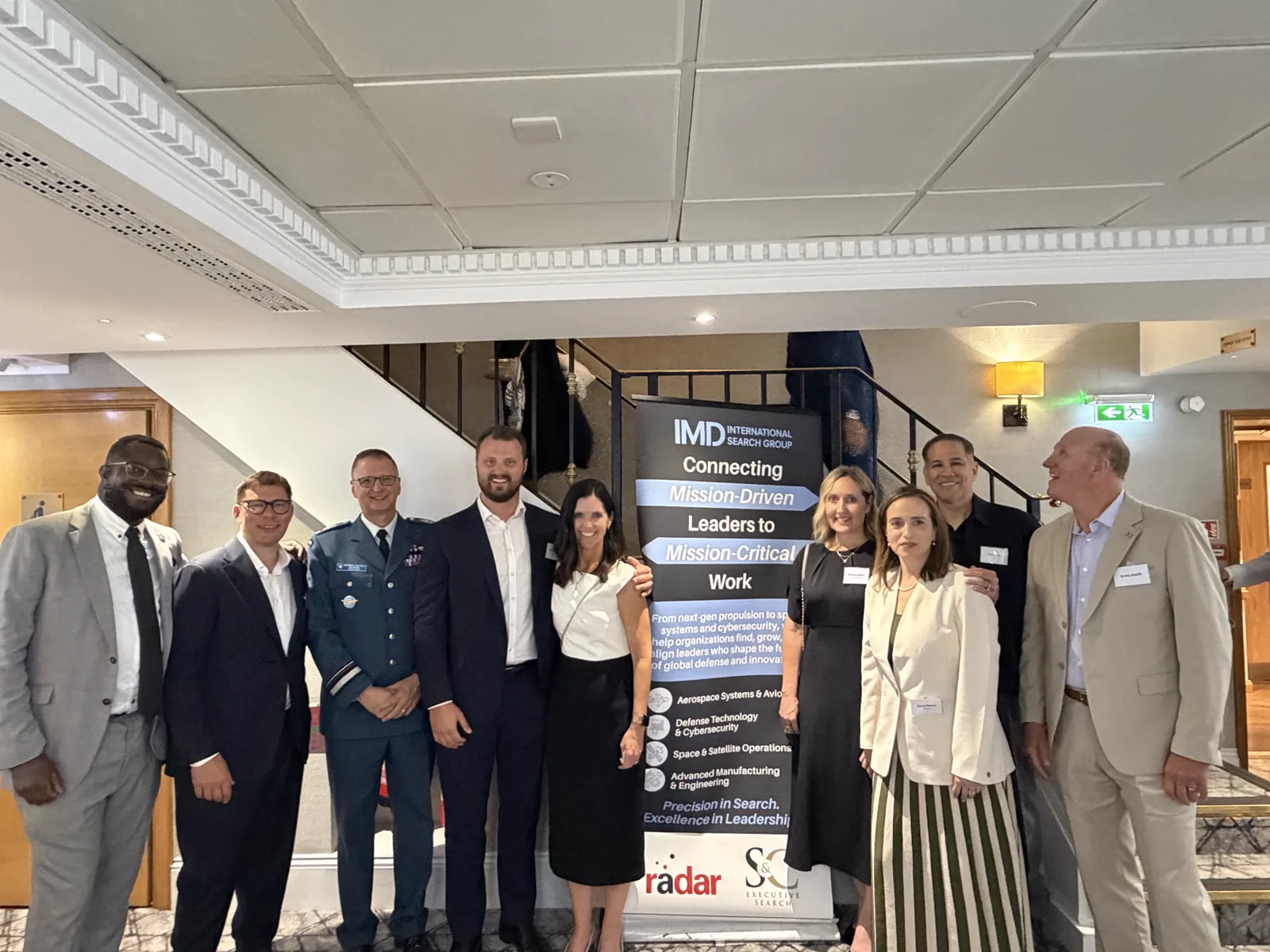
Our conversations this week with clients and candidates at our IMD International Search Group Aerospace Practice network — captured in the photo above at our partner gathering on Day 3 — kept returning to the same operating reality: the leadership profile the sector needs next is different from the one it hired for last cycle.
A few threads that recurred across Day 3:
- The plant leader for an autonomy-adjacent program is a different animal than the plant leader for a conventional aerospace transfer. Cyber-physical integration on the floor, tighter security clearances, software-in-the-loop testing regimes, and modular-payload discipline are showing up as day-one requirements, not stretch skills.
- Program leaders now have to hold three timelines at once — a certification timeline, an autonomy-integration timeline, and a sovereign-capability timeline that answers to a government customer as well as a commercial one. The number of executives who have carried all three is small, and it is a market of its own.
- Energy strategy is entering the executive job description. COOs and site GMs are being asked to opine on power procurement, on-site generation, and utility-grade uptime alongside the classical operations agenda. That reshapes both the profile and the assessment.
- Software and cyber-physical fluency has to sit above the CIO line. VP Engineering and Chief Program Engineer candidates who are fluent across mechanical, avionics, and software domains are the profile every conversation gravitated toward this week — and the pipeline is thin.
The retained-search response to this is not to write bigger job descriptions. It is to build tighter assessment frameworks that can distinguish an executive who really operates across cyber-physical boundaries from an executive who can present slides about them.
Wrapping up FIA2026
Farnborough remains a powerful reminder that the future of aerospace will be shaped not only by new technologies but by the people and organizations capable of deploying them. The autonomy, unmanned, and sovereign-capability announcements will keep filling headlines through the second half of the decade. The leadership infrastructure — the engineering benches, the certification-fluent VPs, the plant leaders who can carry an autonomy-adjacent program through a transfer — is what actually determines whether those announcements convert into aircraft, systems, and capability on the ramp.
Grateful, again, to our partners across the IMD International Search Group Aerospace Practice network — from radar (UK), S&C Executive Search, and colleagues joining us from across regions — for the depth of the conversations this week. That is the team behind the banner in the photo, and it is the team behind our work in this sector wherever it emerges.
More reflections from the week to follow. If you would like to continue any of these conversations, the simplest route is through the practice and we will coordinate.
#FIA2026 · #Aerospace · #CyberPhysical · #Manufacturing · #FutureOfWork · #DefenseTech
Jose J. Ruiz is CEO and Managing Partner of Alder Koten, President of IMD International Search Group, and Chairman of Anker Bioss.