
Insights
AI and Organizational Design: The Chain Leaders Miss
AI and organizational design are one question: AI moves decisions, decisions move authority and accountability, and judgment still has to be grown in work.
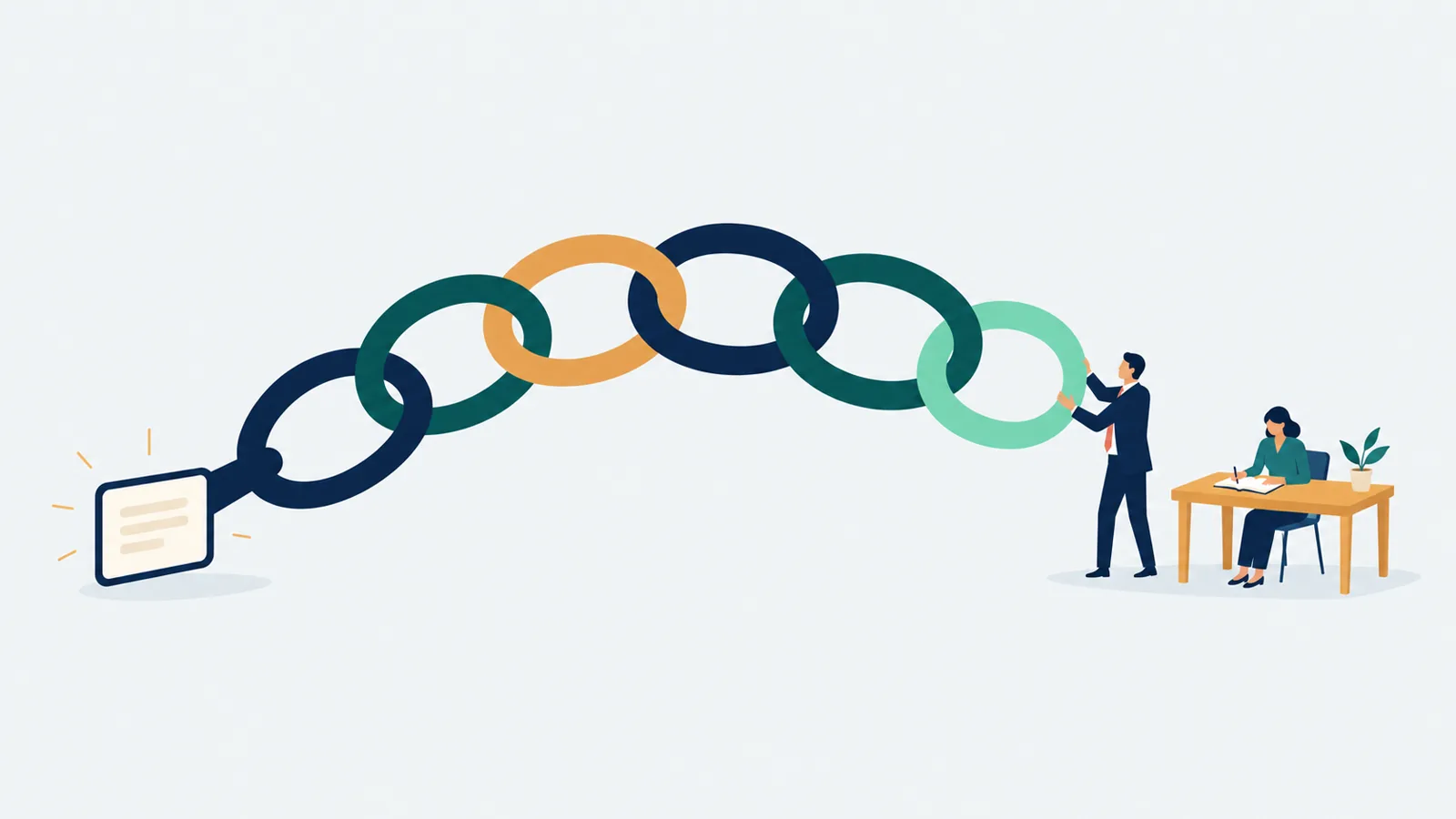
Most AI programs are approved as technology projects and reviewed as cost projects. Neither framing catches what changes. When a model starts shaping a pricing call, a credit limit, or a shortlist of candidates, the first thing that moves is not the tech stack. It is the decision. That makes AI and organizational design the same question, whether or not the steering committee treats them that way.
The argument runs as a chain, and every link pulls on the next one. AI changes decisions. Decisions change authority. Authority changes accountability. Accountability depends on judgment. Judgment develops through work. So AI forces leaders to reconsider how work and the organization are designed. Skipping a link is where most deployments go wrong.
How does AI change decisions, and why does that move authority?
AI rarely makes a decision outright. It changes which options reach the person deciding, in what order, and with how much apparent confidence. A forecast that arrives already ranked has done part of the choosing.
Authority is the right to commit the organization to a course of action. Once a system frames the options, part of that right has moved, often to whoever configured the system’s thresholds. The org chart still shows the plant director or the CFO as the decision-maker. The real work of selecting has moved upstream, into a vendor setting or an analyst’s prompt. The gap between formal and real authority is where trouble starts, as the incomplete org chart explores.
If authority moves, where does accountability go?
The canon this practice works from separates two things that everyday language blurs. “Responsibility is about doing the work right within a stated envelope. Accountability is about ensuring the work is right to do.” Accountability sits with the manager of the work, who owns the integrity of the system around the task: clear mandate, decision rights, interfaces, and review.
AI tests that separation directly. If the system frames the decision, who owns the frame? Most companies have not answered. In KPMG’s Global AI Pulse for Q2 2026, a survey of 2,145 senior leaders, only 24 percent said the CEO is accountable for AI-driven business outcomes. Where CEOs did hold that accountability, leaders reported far higher confidence in their AI strategy. Accountability that no one has designed does not disappear. It defaults to whoever is closest when something breaks.
Why does accountability depend on judgment, and judgment on work?
Being accountable for a decision you cannot evaluate is a formality, not accountability. To answer for an AI-shaped decision, a leader has to tell when the recommendation is wrong. That is judgment: “the process of weighing factors, knowledge, experience, and non-verbalized insight to reach a decision.”
The phrase that matters is non-verbalized insight. It builds up through years of doing the work: reconciling the ledger by hand, walking the line when yields drop, sitting in the negotiation that went sideways. The Glacier and BIOSS tradition behind this practice has held for decades that capability grows when people take on work that stretches them, with real discretion and real consequences.
This is why the chain closes on work design. The tasks AI absorbs first are often the ones where judgment used to be formed. MIT Technology Review reported in May 2026 on a Stanford Digital Economy Lab working paper. It found that workers aged 22 to 25 in the most AI-exposed occupations saw a 16 percent relative decline in employment after generative AI spread. Fewer entry seats today means fewer seasoned judges in ten years.
What should leaders redesign first?
Start with the decisions, not the tools. For each consequential decision AI now touches, identify the Judgment Point: “a moment within a Judgment Chain at which human interpretation, discretion, values, or choice materially changes what follows.” Then ask four plain questions:
- Who holds authority? Who can override the system, and do they know it?
- Who owns the frame? Who answers for thresholds, data, and review cadence, as distinct from who executes?
- Can the accountable person judge it? Does that person have enough lived experience of the work to recognize a bad recommendation?
- Where does the next generation learn? If AI took the developmental tasks, what replaces them?
The fourth question is the one most programs never reach. Development has to be designed back into roles on purpose: rotations through exception handling, reviews of what the model got wrong, or assignments where the human decides first and checks the system second.
A composite example: a mid-sized industrial distributor automated its credit approvals and cut cycle time sharply. Eighteen months later, its first major customer default exposed the gap. No one below the CFO had approved a difficult credit in over a year, and nobody could explain why the model had passed the account. The model worked. The organization had stopped producing people who could check it.
Frequently asked questions
How does AI affect organizational design? AI changes how decisions are framed and made, which moves real authority away from the roles the org chart names. Organizational design has to follow: redrawing decision rights, assigning ownership of thresholds and review, and rebuilding the work through which people develop the judgment to hold that accountability.
Who is accountable when an AI system makes a bad recommendation? The manager of the work remains accountable for the integrity of the system around the decision, including its data, thresholds, and review cadence. The person who executes is responsible for doing the task within its limits. If nobody has been named for the frame, accountability falls by default to whoever is nearest when it fails.
Why does AI threaten the development of future leaders? Judgment builds up through doing consequential work with real discretion. AI tends to absorb the routine and entry-level tasks where that learning used to happen. Without deliberate redesign, organizations end up with fewer people who have practiced the judgment needed to question an automated recommendation.
What is the first step in redesigning work for AI? List the consequential decisions AI now shapes and mark the moments where human judgment changes the outcome. For each one, name who holds authority, who owns the frame, whether that person can evaluate the output, and where people still build the experience to do so.
Redesigning decision rights, roles, and development paths around AI is organizational work, and it is the core of Anker Bioss’s organizational advisory. The full argument is developed in AI in the Org Chart. To discuss how it applies to your leadership team, start a conversation.
Jose J. Ruiz is CEO of Alder Koten and Chairman of Anker Bioss.