
Insights
The Incomplete Org Chart: Why AI Governance Fails
AI governance keeps failing because the org chart shows agents and supervisors but not reliance, authorship, or ownership. Where accountability actually lives.
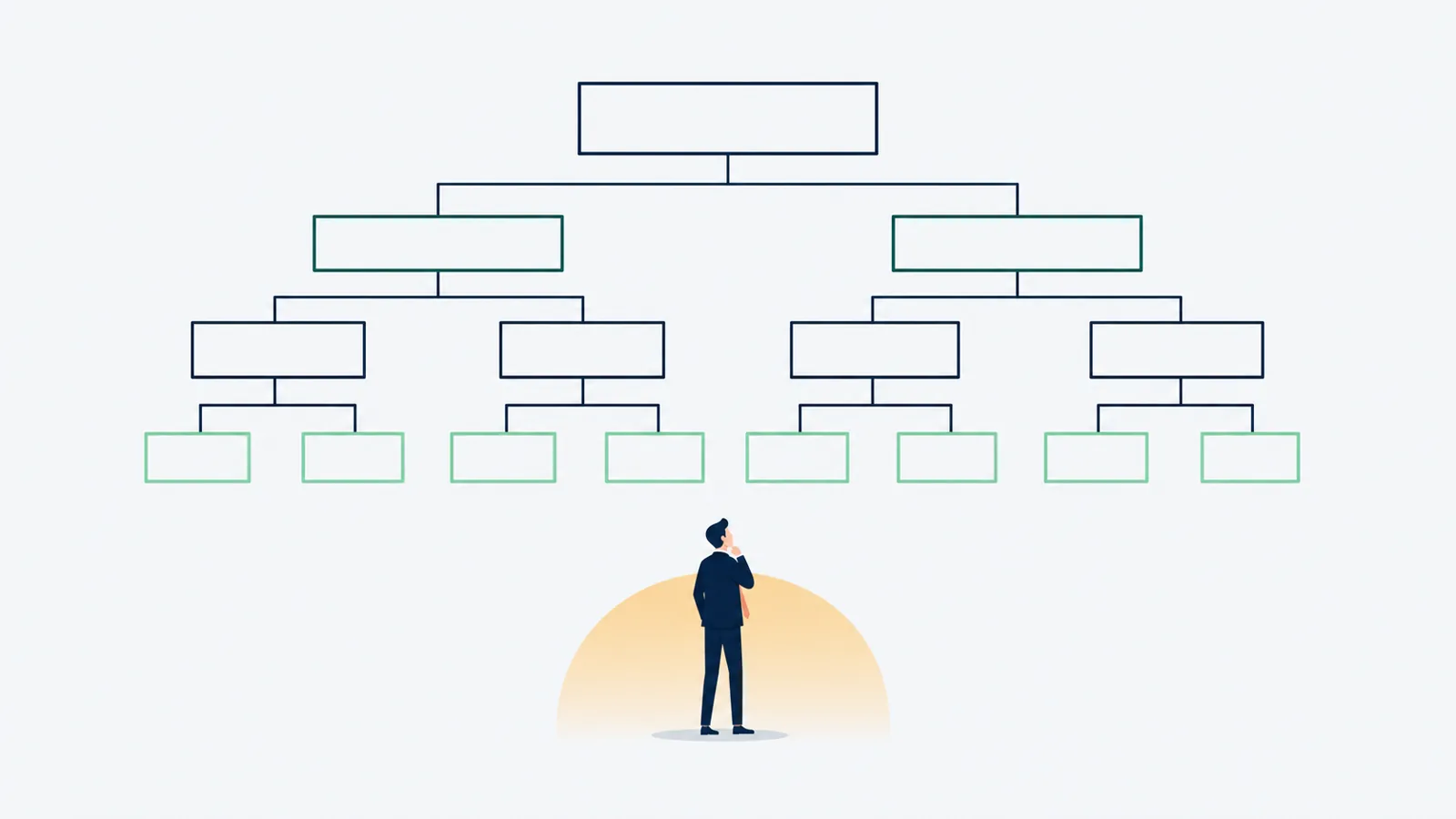
Most AI governance work starts in the wrong place. It begins with the tools — models, thresholds, dashboards, review boards — and then asks who supervises what. That order feels responsible. It is also how the incomplete org chart gets built. A company can name every agent, assign every sponsor, publish every threshold, and still not know who owns the moment a machine’s answer becomes advice a customer relies on. A chart can be finished while the organization it describes is not.
If you are implementing AI in a real operating environment, this is the failure mode to name first. What follows is one way to see it, name it, and design around it.
What is the incomplete org chart?
The incomplete org chart is a governance artefact that shows every AI agent and every human sponsor in the workflow, but does not show three things that decide whether the system remains accountable: reliance, authorship, and ownership of the moment a recommendation becomes advice. It looks complete because every box is filled. It is incomplete because the boxes describe supervision, not authority.
Consider a retail company that has done what most companies have not: it has named its agents on the chart. A service agent handles customer conversations. An in-store humanoid handles fitting. A forecasting agent handles demand. A finance agent handles the margin narrative. Each has a sponsor, a threshold, and a dashboard. The board reviews them. The company is faster, smaller, and more profitable. And then a children’s jacket — technically compliant, well-priced, correctly recommended — starts coming back. Not because it failed. Because it was suitable in the model’s terms and unsuitable in the parents’ terms. Nobody in the room can name the person who could have stopped the recommendation before the parents relied on it.
That is the incomplete org chart. Every agent had a supervisor. No one owned reliance.
Why does AI governance keep failing this way?
Because most AI governance frameworks answer a supervision question when the accountability question is different. Supervision asks: who reviews the output before it leaves? Accountability asks: who has the authority, context, and ownership to stop a technically-correct answer from reaching another person as advice, when the answer is humanly wrong? The two questions do not resolve to the same seat on the chart.
Here is the specific failure sequence I keep seeing in AI-forward organisations:
- Each function optimises for its own signal. Product sees fit language without a defect trigger. Service sees exchanges that resolve. Retail sees conversion. Supply chain sees demand. Finance sees leverage.
- Human review happens everywhere the org chart says it should. The dashboards stay green.
- The signals compound quietly across functions before any single dashboard turns red.
- When the consequence lands — cancelled partnerships, customer trust erosion, supplier commitments already made — it is too large to belong to any one function.
- The board asks whose problem it is. Every answer through the chart is partly. None is sufficient.
The failure is not that humans were absent. Humans were present at every review point. The failure is that presence is not judgment. Approval is not authorship. Someone reviewed the classification. Someone approved the script. Someone signed off on the margin narrative. Nobody owned the moment the recommendation became advice.
What the org chart shows — and what it hides
A modern org chart with AI on it typically shows five things well: reporting lines, functional boundaries, supervisor-of-record for each agent, approved permissions, and escalation thresholds. Those are useful. They are not sufficient.
The chart hides four things that matter more for AI accountability:
- Reliance — the moment a person starts acting as if the system’s answer can be trusted without independent verification. Reliance is not a permission granted on the chart; it is a behaviour that emerges in the work. A store associate stops re-checking Toma’s recommendation. A controller stops rewriting Ledger’s variance language. A customer treats the machine’s phrasing as the company’s promise. None of that is authorised. All of it happens.
- Authorship — the person whose judgment shaped the output the customer actually experiences. The chart shows who approved the script. The chart does not show who authored the promise the script implies. When a machine speaks in the company’s voice, the company has authored a claim. Somebody has to be responsible for that authorship, not merely for reviewing the words afterward.
- The threshold from recommendation to advice — when a system compares options, that is a recommendation. When a customer relies on the comparison to make a decision that touches their child, their money, or their health, that recommendation has become advice. The chart does not mark where the threshold sits or who guards it.
- The authority to stop a profitable answer — every AI-forward company has language about “human in the loop.” Very few have named the person who is authorised to stop a green workflow because the answer is technically right and humanly wrong. Without that seat, the loop closes around consent rather than judgment.
The Second Map of Work
The book’s central concept is what I call the Second Map of Work. The first map is the org chart every company already has — reporting lines, functions, permissions, and now AI agent boxes. The Second Map traces something the first map cannot show: the path a decision actually travels once AI enters the workflow.
The Second Map answers four questions the org chart does not:
- Where does AI first shape an answer? Not where a tool is deployed, but where the first framing move happens — the moment a system narrows the range of possibilities that will be considered.
- Where does a human first encounter the output? The first person to see a system’s work is not always the person authorised to change it. The Second Map distinguishes exposure from authority.
- Where does reliance begin? The point at which a person stops treating the output as a suggestion and starts treating it as the basis for their own action. Reliance is often invisible to the chart and to the person themselves.
- Where does the consequence reach another person? The customer, the candidate, the employee, the supplier. This is the moment the organisation’s answer becomes real for someone outside the workflow. Ownership of this moment is the definition of accountability in an AI-enabled organisation.
The distance between the four points is where accountability quietly erodes. Every AI failure I have seen in a real organisation lives in that distance.
What leaders should do this quarter
The move that matters is not a framework rollout. It is a change of question. Not a new committee or a thicker risk register. A smaller, sharper question. Where does reliance begin, and does the person at that point know the choice is theirs? Leaders should ask the same question inside their own organisation. In practice, that means:
- Walk one AI-enabled customer or employee moment end to end, from first framing to consequence, and mark the four points of the Second Map on your own workflow.
- Identify the point where recommendation becomes advice. Name the person authorised to stop it. If nobody can be named, that is the seat to design.
- Audit your dashboards for the gap between presence (human reviewed) and judgment (human authored the decision). Where they diverge, the org chart is incomplete for that workflow.
- Give the person at the point of reliance explicit permission — visible on the chart — to interrupt a green workflow when the answer is technically right and humanly wrong.
None of this requires new technology. It requires seeing the second map that already runs beneath your first one.
Frequently asked questions
What is the incomplete org chart in AI governance? The incomplete org chart is an organisational diagram that shows every AI agent and every human supervisor but does not show reliance, authorship, or the ownership of the moment a machine’s recommendation becomes advice a person acts on. It looks complete because every box is filled, yet fails because supervision is not the same thing as accountability.
What is the Second Map of Work? The Second Map of Work is a framework for tracing where AI first shapes an answer, where a human first encounters it, where reliance begins, and where consequence reaches another person. It runs beneath the traditional org chart and is where AI accountability actually lives.
Why does having a human in the loop not solve AI accountability? Because a human can be present at every review point and still not be the author of the decision. Presence is not judgment. Approval is not authorship. Accountability requires naming the person authorised to stop a technically-correct answer from reaching another person as advice — and that seat is rarely on the chart.
Who is responsible for AI accountability in an organisation? Accountability sits with the person authorised to stop a technically-correct answer from reaching another person as advice. That is rarely the AI supervisor of record on the org chart. It is usually closer to the point where a customer, employee, or partner actually acts on the output — which is why the chart needs a second map layered onto it.
Jose J. Ruiz is CEO and Managing Partner of Alder Koten and Chairman of Anker Bioss. He develops these ideas at book length in AI in the Org Chart: A Leadership Guide to Implementing AI Without Losing Human Judgment, Accountability, and Trust, published by Elavant Press and available on Amazon.
If you would like to talk through how the Second Map of Work applies to your organisation, reach the practice through the contact page.