
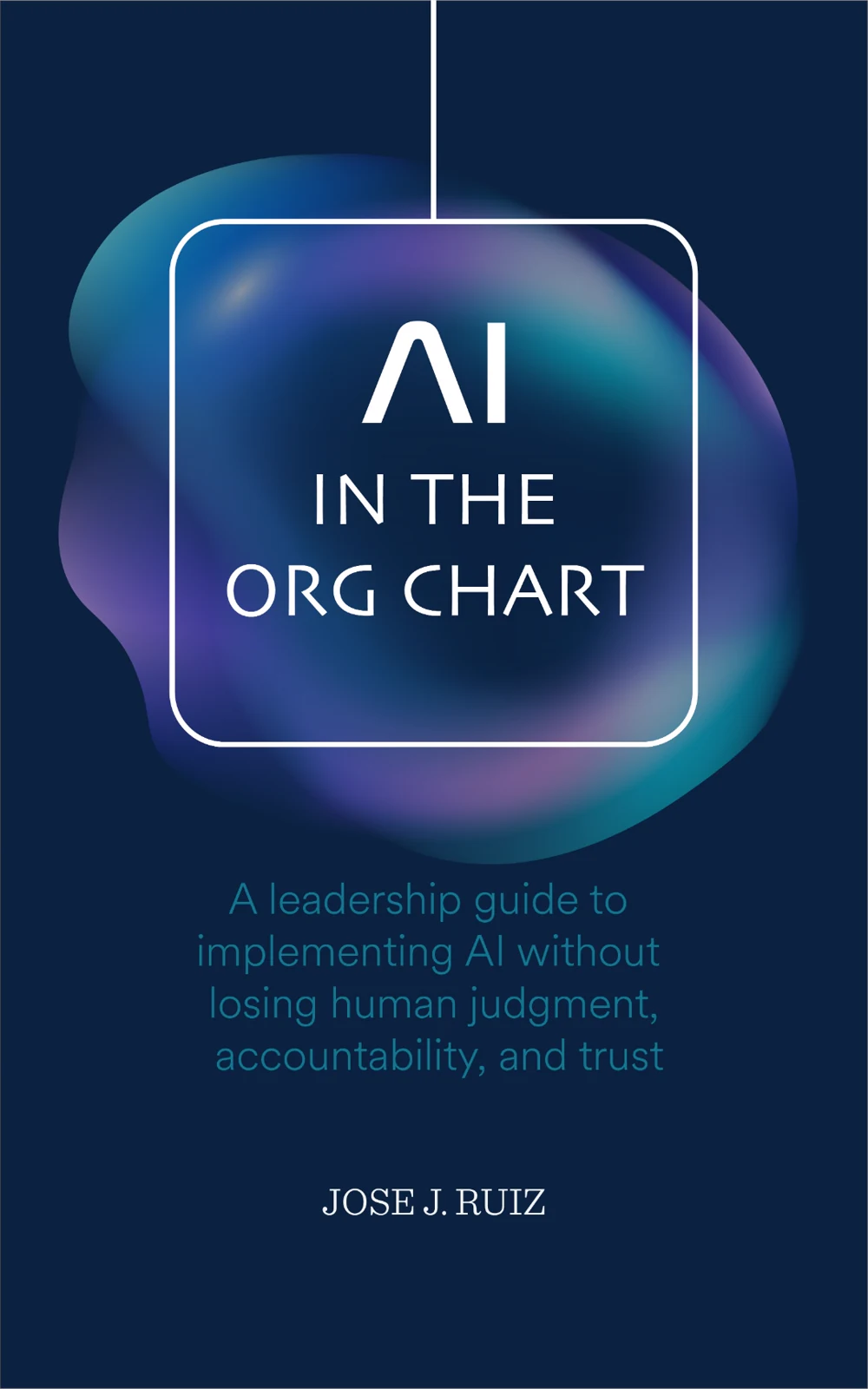
AI in the Org Chart
A Leadership Guide to Implementing AI Without Losing Human Judgment, Accountability, and Trust
Published August 2026 · by Jose J. Ruiz
About the book
Most books on AI at work treat it as either a productivity multiplier or a threat to be managed. AI in the Org Chart treats it as something more consequential: a design question about where machine capability belongs inside the human structure of a company — and what has to stay unambiguously human when it does.
The premise is direct. AI extends ability — the speed and scale at which a task can be executed. It does not extend capability — the judgment that holds complexity across time, with accountability. Confusing those two is how organizations end up with faster mistakes, faster bureaucracy, and a diluted sense of who is actually responsible for what.
What the book gives leaders
- A working distinction between the parts of a role AI can extend and the parts it cannot — and how to redesign the role instead of pretending the seam isn’t there.
- A framework for placing AI in decisions: where it accelerates human judgment, where it substitutes for it, and where substitution should be refused.
- Accountability patterns that survive AI adoption — how to keep decision rights, audit trails, and stewardship intact when the workflow now includes non-human actors.
- Language for the trust conversation with boards, regulators, customers, and employees — the four constituencies most likely to lose confidence first when AI implementations go sideways.
- Diagnostics for the failure modes leaders keep encountering: capability atrophy, invisible dependency, quiet erosion of accountability, and the “automation of the wrong things.”
Who it’s for
CEOs, boards, chief people officers, chief AI officers, and the operating executives who own the roles being redesigned. Also for the search, advisory, and assessment practitioners advising them — the people who see the same redesign question from many companies at once and are being asked to name the pattern.
Where it fits in the series
AI in the Org Chart extends the argument from The Capability Advantage into the AI era. Where The Capability Advantage built the case that capability, not ability, is the durable asset — this book asks what happens to that asset when the ability layer is suddenly abundant, cheap, and machine-supplied. It sits alongside The Leadership Competency Playbook and Selling By Design as the third practitioner-facing extension of the Elavant / Anker Bioss framework.