
Insights
The Board Mandate: Designing the Boundaries of Governance
The Board Mandate is the boundary architecture through which shareholders define where board judgment begins, escalates, delegates, and ends.

Boards are often told what they are responsible for. They are rarely given an equally precise description of where their authority ends.
That distinction creates one of the persistent problems in corporate governance. A board may have a charter, committee structure, fiduciary obligations, approval authorities, and an annual calendar and still lack a usable architecture for exercising judgment. Directors know what subjects belong on the agenda, yet remain uncertain about when they should intervene, when they should escalate, when they should collaborate, and when they should deliberately leave the Executive Team alone.
The ambiguity becomes visible when consequential decisions arrive.
A major acquisition emerges. A strategic assumption no longer holds. The CEO proposes entering a market that changes the risk profile of the enterprise. A shareholder principle collides with an attractive commercial opportunity. Directors become uncomfortable with a strategic choice but cannot identify whether their discomfort calls for challenge, oversight, intervention, or escalation.
Without explicit boundaries, governance starts depending on personalities.
A strong chair can hold the line. An experienced CEO may know how to keep directors appropriately engaged. Sophisticated shareholders may communicate their expectations through years of accumulated interaction. The arrangement can work remarkably well until one of those people changes.
Institutional governance should not depend on everyone remembering an unwritten agreement.
The Board Mandate provides another way to think about the problem. It treats governance as an architecture of boundaries.
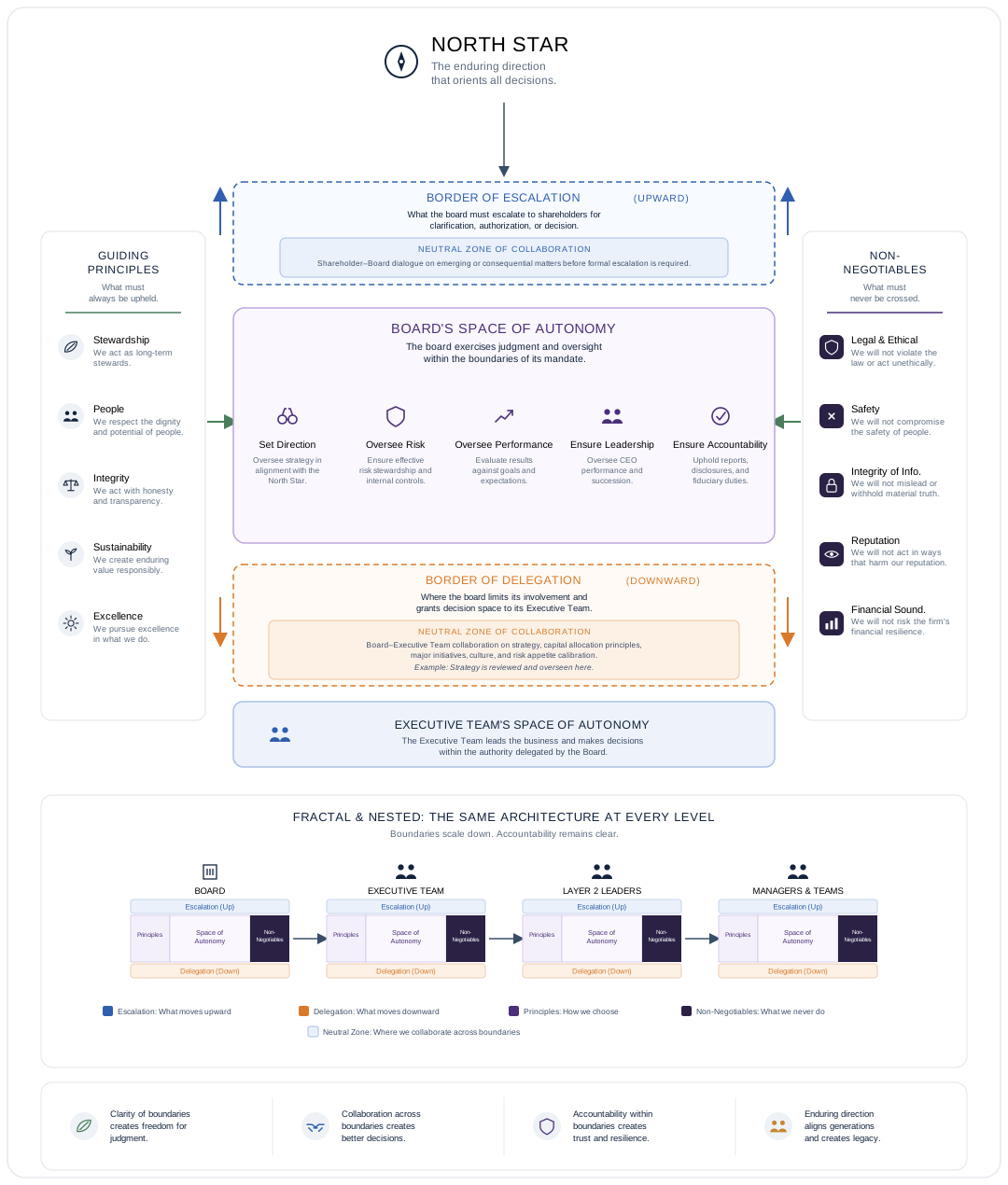
A mandate is different from a charter
A conventional board charter usually describes duties, composition, committees, procedures, reserved matters, and legal responsibilities. Those elements matter. They establish formal governance machinery.
A Board Mandate serves a different purpose.
The Board Mandate is the boundary architecture through which shareholders define the board’s legitimate exercise of judgment.
The distinction is important. The mandate is not everything the board does inside a box. The mandate is formed by the boundaries themselves.
Those boundaries answer four different questions:
- What must the board escalate to shareholders?
- What must the board leave to the Executive Team?
- What principles must always guide the exercise of judgment?
- What lines must never be crossed?
The architecture therefore has four boundaries: an upper Border of Escalation, a lower Border of Delegation, Guiding Principles on one side, and Non-Negotiables on the other.
Above the entire architecture sits the North Star.
The resulting model changes the governance question. Instead of asking only, “What is the board responsible for?” shareholders and directors can ask, “Within what boundaries should the board exercise judgment?”
That question creates a very different conversation about authority.
The North Star sits above everyone
Every governance system needs direction before it needs boundaries.
The North Star provides that direction. It expresses the enduring orientation of the enterprise and gives shareholders, directors, and executives a common reference point against which to exercise judgment.
The North Star sits above everyone because no governance body should casually bend enduring direction around its immediate interests. The board does not own the North Star. The Executive Team does not own it. Individual shareholders should not treat it as a convenient slogan that changes whenever circumstances become uncomfortable.
A useful North Star should be durable enough to orient decisions across changes in strategy, leadership, markets, and operating conditions.
That durability does not mean permanence. An enterprise may eventually need to reconsider its fundamental direction. The governance architecture simply requires the reconsideration to occur at the appropriate level rather than allowing strategic or operating decisions to redefine the enterprise implicitly.
The North Star therefore serves as an orientation point rather than another approval mechanism.
Below it begins the mandate.
The upper boundary defines escalation
The Border of Escalation defines the point at which the board reaches the limit of the authority shareholders have delegated to it.
Shareholders should make that border explicit.
Certain decisions may change the character of the enterprise, expose shareholders to risks they have chosen to retain, alter fundamental commitments, or require a judgment that shareholders have deliberately reserved for themselves. The mandate should identify those conditions before a live issue makes the question politically difficult.
The purpose is not to create a long catalog of approvals. Excessive reservation defeats the purpose of having a board capable of exercising judgment.
The Border of Escalation should instead clarify the kinds of questions the board cannot legitimately settle alone.
When a matter crosses that border, escalation is not evidence that the board has failed. Escalation is the governance architecture working as designed.
That framing matters because poorly designed organizations often treat escalation as weakness. People learn to hold decisions too long, disguise uncertainty, or manufacture confidence because taking an issue upward carries social or political cost.
A clear border changes the meaning of escalation. The board can say, in effect, “The issue has reached the limit of our mandate. Shareholder clarification is now required.”
Authority remains explicit.
The lower boundary protects executive autonomy
The Border of Delegation performs the complementary function.
It tells the board where to stop.
Boards frequently focus on whether management has appropriate limits. Less attention goes to whether the board itself has limits on its involvement with management. Yet executive autonomy depends as much on board restraint as it does on formal delegation.
A board can delegate something on paper and reclaim it in practice.
Directors can request repeated approvals. They can prescribe methods through detailed questioning. They can use informal relationships with executives to shape operating decisions outside governance forums. They can turn requests for visibility into shadow management. None of those behaviors necessarily changes the formal allocation of authority. Collectively, they can eliminate the Executive Team’s meaningful Space of Autonomy.
The Border of Delegation addresses the problem directly.
It specifies where board involvement should diminish because the work belongs to the Executive Team. The board remains accountable for governance and oversight. Directors retain the right to understand whether the enterprise is being directed competently and whether commitments are holding. They do not need to occupy the decisions they oversee.
That separation becomes particularly important during periods of stress.
When performance deteriorates, directors naturally want more information. More information can quickly become more involvement. More involvement can become decision substitution. The Executive Team then begins managing toward board reactions rather than exercising judgment within its own authority.
A good mandate gives the board something to hold onto when anxiety increases: a boundary.
Principles guide judgment where rules cannot
Vertical boundaries clarify the movement of authority. The lateral boundaries constrain how judgment is exercised within that authority.
On one side sit the Guiding Principles.
Guiding Principles state what shareholders expect the board to uphold consistently. They provide affirmative guidance for situations that cannot be fully anticipated when the mandate is written.
That distinction separates a principle from a procedure.
A procedure tells someone how to handle a known situation. A principle helps someone exercise judgment when circumstances vary, facts are incomplete, or competing interests must be reconciled.
Shareholders might establish principles concerning the treatment of employees, preservation of financial resilience, allocation of capital, relationships with communities, treatment of customers, or the balance between generations in a family enterprise. The specific content belongs to the shareholders. The architectural requirement is that the principles be explicit enough to influence judgment.
A principle that cannot help a director make a difficult choice has limited governance value.
Guiding Principles also reveal something about ownership. Shareholders inevitably have beliefs about how the enterprise should behave. Leaving those beliefs implicit does not make them disappear. It simply forces directors and executives to infer them, often after a decision has already exposed a difference in expectations.
Explicit principles turn preference into usable governance guidance.
Non-Negotiables establish the hard lines
On the opposite boundary sit the Non-Negotiables.
If Guiding Principles express what should always be upheld, Non-Negotiables express what must never be crossed.
The distinction deserves precision.
A Guiding Principle informs judgment. A Non-Negotiable removes certain choices from legitimate consideration.
Shareholders may determine that particular businesses, financing structures, ethical compromises, concentrations of risk, ownership arrangements, reputational exposures, or other actions are unacceptable regardless of their projected financial return. Those choices establish the hard edge of the board’s mandate.
Non-Negotiables should be used carefully. If everything becomes non-negotiable, directors have little meaningful authority. If nothing is non-negotiable, shareholders may discover that their fundamental assumptions about ownership existed only in their heads.
The discipline lies in identifying the few boundaries that genuinely deserve hard-line treatment.
Clarity before the decision matters. Declaring something non-negotiable after the board has exercised legitimate judgment is not governance architecture. It is retroactive control.
Boundaries need Neutral Zones of Collaboration
A simple diagram can make governance look cleaner than organizational life actually is.
Authority does not always move across razor-thin lines. Some work legitimately requires sustained interaction between the parties on either side of a boundary. Treating every interaction as either “inside” or “outside” the mandate makes the architecture unnecessarily deterministic.
The model therefore benefits from a Neutral Zone of Collaboration embedded in a boundary.
A Neutral Zone of Collaboration is an intentionally defined area where the parties on either side of a governance boundary engage with one another while preserving the underlying allocation of accountability.
The distinction between collaboration and shared accountability is critical.
Collaboration permits dialogue, challenge, sensing, interpretation, and learning across the border. It does not automatically transfer ownership of the work.
Strategy provides the clearest example.
Strategy can sit in the Neutral Zone of Collaboration along the Border of Delegation. The Executive Team develops strategy, translates strategic choices into plans, organizes resources, and executes. The board reviews strategy, challenges assumptions, tests coherence, considers risk, and oversees progress.
Serious board involvement is appropriate. Executive ownership remains intact.
The Neutral Zone prevents two familiar governance failures. The first is a passive board that receives strategy as a finished presentation and treats oversight as approval. The second is an intrusive board that effectively becomes a strategy department above management.
The border can accommodate collaboration without requiring either failure.
A similar zone can exist along the Border of Escalation. Boards and shareholders may discuss emerging questions before a formal escalation threshold is reached. Dialogue can clarify intent and reduce surprises without turning shareholders into shadow directors.
The boundary remains real. The zone makes the boundary usable.
The architecture is fractal
The most consequential property of the model appears when the Board Mandate is viewed as part of the larger organization rather than as an isolated governance device.
The architecture is fractal and nested.
A fractal pattern retains recognizable structural logic as it appears at different scales. Governance and organizational authority can work in the same way.
Shareholders create a bounded Space of Autonomy for the board. The board creates a bounded Space of Autonomy for the CEO and Executive Team. The CEO establishes boundaries with executives. Executives establish boundaries with managers. Managers establish boundaries with teams and individual contributors.
The content changes at every layer. The architecture remains recognizable.
Every legitimate Space of Autonomy requires answers to similar questions: What direction orients the work? What must be escalated? What should be delegated? What principles govern judgment? What lines cannot be crossed? Where is collaboration across a boundary expected?
This fractal quality creates organizational coherence without requiring centralization.
The board’s Border of Delegation can become part of the Executive Team’s upper Border of Escalation. What one layer deliberately releases becomes the legitimate territory of another. Further down, the pattern repeats.
The same principle applies to lateral boundaries. Guiding Principles can propagate through the organization while becoming more specific in application. Non-Negotiables established at the shareholder level can create constraints that successive layers must preserve.
The architecture therefore allows authority to travel while maintaining traceability to its source.
Good governance requires restraint as well as action
Board effectiveness is often discussed in terms of what directors should do: challenge management, oversee risk, monitor performance, approve strategy, select the CEO, plan succession.
Those activities matter. They provide an incomplete picture.
Governance also depends on knowing what not to do.
A director who understands a Border of Delegation knows that having experience in a subject does not create authority over the subject. A board that understands its Border of Escalation knows that institutional significance can require shareholder clarification even when directors believe they know the answer. Guiding Principles help directors act when no rule can resolve the issue. Non-Negotiables remind them that some attractive choices remain outside legitimate territory.
Neutral Zones of Collaboration make the architecture human enough to function.
The result is neither a weak board nor an all-powerful board. It is a board with a defined Space of Autonomy and enough clarity to use it.
That distinction becomes more valuable as organizations grow in complexity. When authority is ambiguous, complexity pulls decisions upward. Senior people become routing mechanisms for uncertainty. Meetings multiply because nobody knows where judgment legitimately resides. Boards drift toward management because visibility feels safer than delegation.
Boundary architecture works in the opposite direction. It allows judgment to remain close to the level where legitimate authority and relevant knowledge meet.
The mandate should be designed before it is tested
The worst time to discover a governance boundary is during a crisis.
A disputed acquisition, sudden CEO departure, liquidity problem, activist challenge, ethical controversy, family disagreement, or strategic rupture places enough pressure on the governance system already. Trying to determine the underlying allocation of authority in the middle of the event compounds the difficulty.
Shareholders and boards should therefore design the mandate when they have room to think.
The work begins with the North Star: What enduring direction should orient the enterprise?
Then the four boundaries become explicit.
Shareholders clarify which matters require escalation. The board and shareholders establish where executive autonomy begins. Shareholders articulate the principles directors should consistently uphold and the hard lines they should never cross. The relevant parties identify where Neutral Zones of Collaboration will improve judgment without confusing accountability.
The resulting mandate should remain concise enough to use.
A fifty-page document may achieve legal completeness while failing as an instrument of judgment. Directors need to be able to recall the architecture when a live decision creates uncertainty. Executives need to understand the lower border well enough to recognize legitimate board involvement and inappropriate encroachment. Shareholders need to recognize when they are clarifying the mandate and when they are bypassing it.
The mandate should also be revisited as the enterprise evolves. A boundary appropriate for a founder-controlled business may no longer fit an institution with dispersed ownership. A Neutral Zone useful during a major transformation may need to narrow once the new operating model stabilizes. A strategic shift may expose a previously invisible shareholder Non-Negotiable.
Renewal does not weaken the mandate. Deliberate renewal keeps implicit changes from hollowing it out.
From governance by personality to governance by architecture
Many boards operate effectively because experienced people have developed an intuitive sense of their boundaries.
That arrangement can be deceptively stable.
A trusted CEO and seasoned chair may negotiate the Border of Delegation through years of interaction. Long-standing directors may understand shareholder Non-Negotiables without seeing them written down. Family owners may know which questions require consultation because the answers have traveled through generations of conversation.
Then someone leaves.
A new CEO interprets board involvement differently. A next-generation shareholder questions an assumption everyone else considered settled. An independent director challenges a practice that previously depended on personal trust. What looked like institutional governance turns out to have been relational memory.
Architecture makes the implicit visible.
The North Star establishes the enduring orientation. The Border of Escalation identifies what the board must take upward. The Border of Delegation protects the Executive Team’s legitimate decision space. Guiding Principles state what shareholders expect to be upheld. Non-Negotiables establish the lines that cannot be crossed. Neutral Zones of Collaboration allow people to work intelligently across those boundaries without dissolving accountability.
The Board Mandate is those boundaries.
Once understood that way, the model reaches beyond the boardroom. The same architecture can nest through the enterprise, creating successive Spaces of Autonomy in which people know where they can exercise judgment, where they need help, what they can entrust to others, and which commitments constrain every choice.
Governance then stops being primarily a question of how much control sits at the top.
The more useful question becomes whether authority has been bounded clearly enough for judgment to travel.
Frequently asked questions about the Board Mandate
What is a Board Mandate? A Board Mandate is the boundary architecture through which shareholders define the board’s legitimate exercise of judgment. It consists of four boundaries: the Border of Escalation, Border of Delegation, Guiding Principles, and Non-Negotiables. The North Star sits above the mandate and provides enduring direction to the governance system.
Is the Board Mandate the area inside the four boundaries? No. The Board Mandate is the four boundaries themselves, not the space enclosed by them. The boundaries define the board’s legitimate Space of Autonomy. Treating the mandate as the contents of a box obscures its primary function: establishing the limits and conditions under which board judgment can operate.
What are the four boundaries of a Board Mandate? The four boundaries are the Border of Escalation (what the board must escalate to shareholders); the Border of Delegation (where the board should limit its involvement and grant legitimate decision space to the Executive Team); the Guiding Principles (what shareholders expect the board to always uphold when exercising judgment); and the Non-Negotiables (hard lines shareholders determine must never be crossed).
What is the North Star in a Board Mandate? The North Star is the enduring direction that orients shareholders, the board, and the Executive Team. It sits above the Board Mandate rather than inside it. The North Star provides a common reference point for judgment across changes in strategy, leadership, and operating conditions.
Is the North Star part of the Board Mandate? The North Star is part of the broader governance architecture but is not one of the four boundaries that constitute the Board Mandate. It sits above the mandate and provides direction to the entire system.
What is the Border of Escalation? The Border of Escalation is the upper boundary of the Board Mandate. It identifies matters that exceed the authority delegated to the board and therefore require shareholder clarification, authorization, reframing, or decision.
What is the Border of Delegation? The Border of Delegation is the lower boundary of the Board Mandate. It identifies where board involvement should end or diminish so the Executive Team has legitimate space to exercise judgment and fulfill its accountability.
What is the difference between the Border of Escalation and the Border of Delegation? The Border of Escalation governs movement upward from the board toward shareholders. The Border of Delegation governs movement downward from the board toward the Executive Team. Together they define the vertical limits of the board’s governance authority.
What are Guiding Principles in a Board Mandate? Guiding Principles are explicit shareholder principles that should always be upheld when the board exercises judgment. They provide direction when rules, policies, and previous decisions cannot fully determine what should be done.
What are Non-Negotiables in a Board Mandate? Non-Negotiables are explicit hard boundaries established by shareholders concerning what the board and enterprise must never do. They remove specified choices from legitimate consideration regardless of potential financial or strategic attractiveness.
What is the difference between a Guiding Principle and a Non-Negotiable? A Guiding Principle guides judgment toward what should always be upheld. A Non-Negotiable establishes a hard limit that must never be crossed. Principles help resolve ambiguity. Non-Negotiables remove prohibited choices from the available decision space.
What is a Neutral Zone of Collaboration? A Neutral Zone of Collaboration is an intentionally defined area within a governance boundary where the parties on either side can interact without transferring the underlying accountability for the work or decision. It allows collaboration across a boundary while preserving distinct Spaces of Autonomy.
Why does a Board Mandate need Neutral Zones of Collaboration? Governance boundaries cannot always operate as deterministic lines. Boards, shareholders, and Executive Teams need to exchange information, challenge assumptions, and develop shared understanding around consequential issues. Neutral Zones of Collaboration allow that interaction without making authority ambiguous.
Where does strategy sit in the Board Mandate architecture? Strategy can sit within a Neutral Zone of Collaboration along the Border of Delegation. The Executive Team develops and executes strategy. The board reviews, challenges, and oversees it. Board engagement with strategy does not require the board to assume executive accountability for developing or executing strategy.
Does the board own strategy? Within this model, the Executive Team owns the development and execution of strategy within its delegated Space of Autonomy, while the board reviews, challenges, and oversees strategy through the Neutral Zone of Collaboration associated with the Border of Delegation. The exact allocation should be made explicit in the governance architecture.
What does it mean to say the Board Mandate is fractal? Calling the architecture fractal means its underlying boundary logic can recur at different levels of the organization. Shareholders establish boundaries for the board. The board establishes boundaries with the Executive Team. The CEO establishes boundaries with executives. Similar patterns can continue through managers, teams, and individual roles. The content changes by level, authority, and complexity. The boundary logic persists.
What does it mean to say the Board Mandate is nested? The architecture is nested because one governance Space of Autonomy connects to another. For example, the board’s lower Border of Delegation connects with the Executive Team’s upper Border of Escalation. Authority can therefore move through successive organizational layers without eliminating accountability at each layer.
How is a Board Mandate different from a board charter? A board charter typically specifies formal responsibilities, composition, procedures, committees, authorities, and governance requirements. A Board Mandate defines the boundaries within which the board exercises judgment. The two instruments can complement each other but serve different purposes.
How does a Board Mandate protect executive autonomy? The Border of Delegation explicitly tells directors where board involvement should diminish. It protects the Executive Team from informal encroachment, repeated approval requirements, and operating intervention that can occur even when authority has formally been delegated.
How does a Board Mandate protect shareholders? The Border of Escalation preserves matters shareholders have retained for themselves. Guiding Principles make shareholder expectations explicit. Non-Negotiables protect hard limits. The architecture gives directors room to govern while preserving shareholder authority over matters that exceed the mandate.
Does a Board Mandate reduce board authority? No. A well-designed mandate legitimizes board authority by making its boundaries explicit. Directors gain meaningful room to exercise judgment because they know which decisions belong to them, which require shareholder involvement, and which should remain with the Executive Team.
Should a Board Mandate contain a long list of reserved decisions? Not necessarily. A mandate should clarify boundaries without converting governance into an exhaustive approval matrix. Excessive reservation can eliminate the judgment the board was established to exercise. Reserved decisions may support the architecture, but they should not substitute for clear principles and boundaries.
Who establishes the Board Mandate? In this model, shareholders establish the mandate through the authority they delegate to the board. Effective design requires dialogue because the boundaries must be sufficiently clear for directors to use and for the Executive Team to understand. Shareholders remain the source of the board’s delegated authority.
Should the Board Mandate ever change? Yes. The mandate should be reviewed as ownership, strategy, organizational complexity, leadership, risk, and institutional circumstances evolve. Changes should be deliberate and explicit. Frequent informal changes weaken the architecture because participants can no longer rely on established boundaries.
What problem does the Board Mandate solve? The Board Mandate addresses ambiguity about the legitimate exercise of board judgment. It reduces dependence on personalities and unwritten expectations by clarifying where the board should act, escalate, delegate, collaborate, uphold principles, and respect hard limits.
What is the central idea behind the Board Mandate model? Effective governance requires clear boundaries that create legitimate room for judgment. The North Star provides direction. The Border of Escalation protects shareholder authority. The Border of Delegation protects executive autonomy. Guiding Principles orient judgment. Non-Negotiables establish hard limits. Neutral Zones of Collaboration allow productive interaction across boundaries without confusing accountability. Because the architecture is fractal and nested, the same logic can extend through successive levels of the organization.
Jose J. Ruiz is CEO and Managing Partner of Alder Koten, President and Chairman of IMD International Search Group, and Chairman of Anker Bioss. This article develops a component of the Anker Bioss Framework — the governance architecture Anker Bioss uses in board evaluations and shareholder-board design engagements.
To discuss how the Board Mandate architecture applies to your board and shareholder structure, start a conversation with the Anker Bioss governance practice.