
Insights
How to Identify, Develop, and Retain High Potential Employees (HiPos)
Every business depends on the quality of its people. Among employees, some consistently show skills, ambition, and a drive that position them as future…
Every business depends on the quality of its people. Among employees, some consistently show skills, ambition, and a drive that position them as future leaders. These individuals are known as high potential employees (HiPos). High potential employees (HiPos) are not just strong performers, they are individuals who can grow into future leaders. Identifying and nurturing them has become a priority for organizations that want long-term stability. Yet research shows that 73% of HiPo programs fail to deliver return on investment because many employees leave despite investment in them.
At the same time, retaining talent is harder than ever. A Gallup survey found that 51% of employees are actively looking for or watching for new job opportunities, increasing the risk of losing top performers. Leadership depth is also shrinking 77% of organizations report they lack sufficient leadership coverage at all levels.
These figures show why organizations must have a structured strategy for identifying, developing, and retaining HiPos. Without it, they risk losing their best talent and weakening their leadership pipeline.
What Are High Potential (HiPo) Employees?
High potential employees are individuals who not only perform well today but also display the capability, ambition, and adaptability to take on significantly more responsibility in the future. They are people you bet on to become the next generation of leaders.
A good way to formalize this is using a competency framework. In this framework, you assess both:
- Technical competencies: the job-specific skills needed for current and future roles
- Workplace competencies: such as decision-making, collaboration, adaptability, and influence
Importantly, companies that identify HiPos in a structured way see better outcomes. For example, a report shows that many organizations consider about 15% of their leaders to be HiPos and 21% to be high performing.
Also, organizations often underinvest in a formal development philosophy: only 18% say they have a fully applied approach to developing their top talent. For companies aiming to build leadership strength, this ties directly to executive search strategies and long-term succession planning.
Thus, defining what HiPo means in your context and being consistent is critical.
High Potential Employee vs High Performance Employee
Organizations often mistake high-performing employees for high-potential employees. While the two categories overlap, they represent different strengths and serve different purposes in long-term talent management.
A high performer is someone who consistently excels in their current role. They meet or exceed expectations, deliver strong results, and are reliable contributors to organizational goals. These employees are essential for maintaining operational excellence and achieving short-term objectives.
A high potential employee not only performs well in their present role but also demonstrates the capability, agility, and ambition to succeed in positions with greater responsibility. HiPos typically show strong leadership capabilities, emotional intelligence, and learning agility. They are seen as future leaders who can play an important role in succession planning and organizational growth.
For example, a sales executive who meets every target is a high performer. But the one who shows leadership competencies, mentors others, and adapts quickly to new challenges may be a HiPo. Recognizing this difference helps organizations invest their development resources wisely.
How to Identify Talented Employees
Identifying talented employees is one of the most important tasks for any organization. Talent is more than just meeting performance targets; it is a mix of skills, behavior, attitude, and growth potential. When managers can spot talent early, they ensure the company has a steady stream of people who can take on greater responsibilities in the future.
Key Indicators of Talent
Several signs point to real talent in the workplace:
- Learning agility: The ability to quickly pick up new skills and adjust to changes.
- Problem-solving ability: Talent often shows in how employees handle unexpected issues with calm and creativity.
- Leadership capabilities: Even without a formal title, talented employees often influence and guide their peers.
- Emotional intelligence: They build positive relationships, communicate clearly, and handle conflict effectively.
- Drive and ambition: Talented employees usually want to grow, take on new challenges, and contribute more to the business.
- Cultural fit and values: Their actions align with the company’s mission and values, making them dependable long-term contributors.
Tools to Identify High Potential Employees
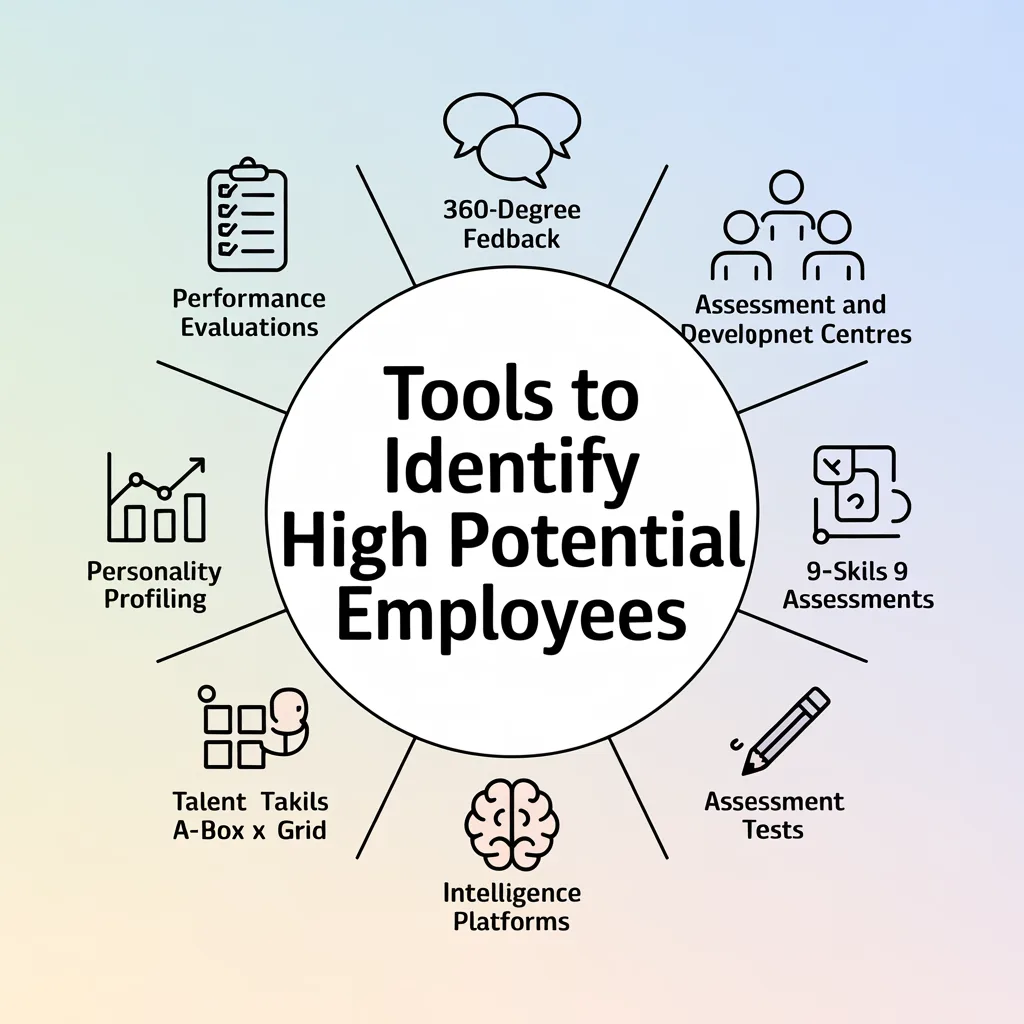
Spotting talent is not only about a manager’s intuition. Modern organizations rely on structured tools and methods that provide fair, objective, and measurable insights. These tools help reduce bias, highlight hidden potential, and give a clearer picture of which employees can grow into future leaders.
1. Performance Evaluations
Traditional performance reviews are still an important tool. They measure how well an employee meets targets, manages tasks, and supports business goals. To identify talent, performance evaluations should go beyond numbers—they should also assess behaviors, teamwork, creativity, and initiative. When done regularly, evaluations provide a clear track record of both consistency and growth.
2. 360-Degree Feedback
This tool collects feedback not only from managers but also from peers, subordinates, and sometimes even customers. It provides a full view of how an employee interacts with others, their leadership style, and their communication skills. For example, someone might appear effective to their boss but may not work well with their team. 360-degree feedback helps reveal such gaps and strengths.
3. Assessment and Development Centres
Assessment centres simulate real work scenarios such as group discussions, role plays, case studies, and presentations. Employees are observed while solving problems, managing conflicts, or leading teams. This tool is very effective in spotting leadership capabilities, problem-solving skills, and learning agility. Development centres take it a step further by combining assessment with coaching to help employees improve.
4. Personality Profiling Assessments
These tests measure personality traits that are linked to success in leadership and team roles. Tools like the High Performance Trait Indicator (HPTI) or the Myers-Briggs Type Indicator (MBTI) can reveal if an employee has qualities like resilience, emotional intelligence, or adaptability. While these should not be the only basis for decisions, they provide useful insights into how a person might handle future responsibilities.
5. 9-Box Grid
The 9-box grid is a simple yet powerful framework. It places employees into nine categories based on two dimensions: performance and potential. High performers with high potential fall into the top-right box and are often marked as future leaders. Those with strong performance but low potential may remain valuable specialists, while others may need more development. This tool makes talent mapping visual and easier for leaders to understand.
6. Talent Intelligence Platforms
Many organizations now use digital platforms that track employee performance, engagement, and growth potential. These platforms provide dashboards, reporting, and analysis to help HR and managers make informed decisions. They can integrate data from performance reviews, assessments, and feedback to identify patterns and highlight rising stars within the company.
7. Skills Assessment Tests
Skills tests measure technical competencies, problem-solving ability, or domain knowledge. They are particularly useful for identifying hidden talent in technical roles where hard skills matter. Combined with workplace competencies, they give a well-rounded picture of employee capability.
Strategies to Develop High Potential Employees
Building a HiPo Development Program
Once HiPos are identified, the next step is structured development. A strong HiPo program is part of broader succession planning. It ensures that when key positions open, the organization already has prepared leaders.
Key components of such programs include:
- Clear career paths and career progression plans.
- Defined leadership competencies aligned with business goals.
- Opportunities for cross-functional projects to expand skills.
- Ongoing coaching and feedback to build confidence and leadership style.
Practical Development Tactics
Beyond formal programs, organizations can use several hands-on tactics to strengthen their HiPos:
- Skills assessment and growth mapping: Identify gaps between current abilities and future requirements.
- Training and development workshops: Provide learning experiences in leadership, decision-making, and communication.
- Job shadowing and mentorship: Pair HiPos with senior leaders to give them exposure and first-hand learning.
- Expanded job responsibilities: Assign projects that push them out of their comfort zone and prepare them for higher roles.
By investing in these methods, companies create a meaningful development journey for employees and strengthen their leadership pipeline.
How to Retain Your High Potential Employees
Identifying and developing HiPos is only half the task; retaining them is equally important. These employees are in demand and can be easily attracted by competitors if they feel overlooked.
Effective retention strategies include:
- Recognition and rewards: Acknowledge their contributions through incentives, promotions, or public appreciation.
- Employee engagement initiatives: Regular check-ins, career discussions, and feedback sessions build trust and loyalty.
- Career paths and progression: Offer clear opportunities for upward movement within the organization.
- Balanced workload: Avoid overburdening HiPos while still challenging them with new opportunities.
- Retention-focused talent management: Use talent retention programs that emphasize growth, training, and career security.
Organizations that retain HiPos effectively build long-term stability and reduce hiring costs.
Measuring and Tracking High Potential
It’s not enough to identify and develop HiPos; organizations must track their progress regularly.
Tracking methods include:
- Performance evaluations are linked to both current role and leadership readiness.
- Competency framework reviews that measure growth in technical and workplace competencies.
- Dashboard, reporting, and analysis from talent intelligence platforms for real-time progress.
- Regular coaching and feedback sessions to ensure alignment with goals.
These measures ensure that the development journey stays on track and HiPos remain aligned with the organization’s long-term vision.
The Benefits of Investing in HiPo Employees
Investing in HiPos provides measurable benefits:
- Succession planning: Builds a pipeline of leaders ready to take over critical roles.
- Employee engagement: HiPos who feel valued and supported contribute positively to workplace culture.
- Improved talent strategy: Aligns the workforce with organizational goals.
- Reduced turnover: Retain HiPo employees through structured development and retention strategies.
- Organizational growth: Employees with capability, agility, and cognitive ability drive better decision-making and innovation.
In short, high-potential employees are not just contributors but future leaders who can guide the company through challenges and opportunities.
Conclusion – Driving Business Success Through HiPos
High potential employees are the backbone of long-term organizational success. Identifying them early through talent assessment tools, developing them with structured programs, and retaining them with clear career progression ensures business growth and stability.
Organizations that treat HiPos as a key part of their talent strategy create a culture of continuous improvement, leadership readiness, and strong employee engagement. By aligning leadership competencies with business goals and building robust succession planning, companies secure a future filled with capable leaders.